

Why Does My Hip Hurt When I Sleep on My Side?


Have you ever settled into bed feeling perfectly comfortable, only to wake up a few hours later with an aching hip? Maybe you find yourself constantly switching sides throughout the night, trying to relieve the pressure. Or perhaps your hip feels particularly sore when you first get out of bed in the morning.
If this sounds familiar, you're certainly not alone. Hip discomfort during side sleeping is a common complaint, and while sleeping position can contribute to the problem, the underlying cause may have more to do with what your muscles and joints experience throughout the day.
Understanding the relationship between your hip muscles, daily movement patterns, and sleeping positions can help you identify potential contributors to your discomfort.
Why Does Side Sleeping Cause Hip Pain?
When you sleep on your side, a significant portion of your body weight rests against the outside of your hip, particularly around a bony prominence called the greater trochanter, located at the top of your thighbone.
Several important structures surround this area, including tendons, muscles, and fluid-filled sacs called bursae that help reduce friction.
Prolonged pressure against these structures can contribute to discomfort, especially when the tissues are already irritated or sensitive.
One common source of pain along the outside of the hip is greater trochanteric pain syndrome (GTPS), which frequently involves irritation or degeneration of the gluteal tendons.
Interestingly, the hip you're lying on isn't necessarily the only one affected. Your upper hip may also become uncomfortable if your top leg drops forward or downward, placing additional tension and compression on the tissues along the outside of the hip.
This is why simply switching sides doesn't always solve the problem.
-Your Daily Body Mechanics May Be Contributing
-Your hips work hard throughout the day, stabilizing your pelvis, supporting your body weight, and allowing you to walk, bend, climb stairs, and change positions.
-Certain habits can place repetitive stress on the muscles and tendons surrounding your hips.
1. Sitting for Long Periods
Prolonged sitting keeps your hips in a flexed position, which may contribute to stiffness in the hip flexors, including the iliopsoas and rectus femoris.
Sitting also reduces the amount of time your gluteal muscles spend actively supporting your body during standing and walking.
Over time, limited movement and reduced muscle conditioning may contribute to weakness or decreased endurance in important hip stabilizers.
2. Standing With Your Weight on One Hip
Have you noticed yourself standing with one hip pushed out to the side?
This common posture, sometimes called hanging on your hip, shifts more of your body weight onto one leg.
It can increase compression around the outside of the supporting hip, particularly near the gluteal tendons.
If you consistently stand this way while cooking, working, or waiting in line, those tissues may experience repeated stress throughout the day.
3. Crossing Your Legs
Frequently crossing your legs can place your hips into positions that increase compression along the outer hip.
For individuals already experiencing irritation of the gluteal tendons, prolonged hip adduction—bringing the thigh across the body's midline—may aggravate symptoms.
4. Walking, Running, and Climbing Stairs
Your hip stabilizers are especially important during activities that require you to balance on one leg. Walking, running, and climbing stairs repeatedly challenge these muscles.
If your hip stabilizers lack adequate strength or endurance for your activity level, other tissues may experience additional stress. Sudden increases in walking distance, running intensity, or stair climbing can also contribute to tendon irritation.
Which Muscles Are Involved in Side-Sleeping Hip Pain?
Several muscles influence how your hips move and how effectively your pelvis remains stable.
Gluteus Medius
The gluteus medius is one of your most important hip stabilizers. Located along the outer portion of your pelvis, it helps keep your pelvis level when standing or walking on one leg.
Weakness or reduced endurance in this muscle may contribute to altered hip mechanics. Its tendon is also a frequent source of outer hip pain.
Gluteus Minimus
Located beneath the gluteus medius, this smaller muscle assists with hip stabilization and movement.
Like the gluteus medius, its tendon can become irritated, potentially producing discomfort along the outside of the hip.
Tensor Fasciae Latae (TFL)
The TFL is a relatively small muscle near the front and outside of your hip. It connects into the iliotibial band (IT band), a thick band of connective tissue running along the outside of your thigh.
This muscle assists with hip movement and stabilization. It may become tender or overworked, particularly when movement patterns place additional demands on the front and outside of the hip.
Piriformis and Deep Hip Rotators
The piriformis and other deep hip rotators help control rotation and stabilize the hip joint.
Tension or sensitivity in these muscles may contribute to deep buttock discomfort, although pain in this region can have several different causes.
Iliopsoas (Hip Flexors)
The iliopsoas helps lift your thigh toward your torso and plays a role in hip and lumbar spine mechanics.
Prolonged sitting may contribute to a feeling of tightness or stiffness in this region. However, tight hip flexors aren't necessarily the cause of outer hip pain.

Tight Muscles vs. Weak Muscles: Why the Difference Matters
One of the biggest misconceptions about muscle discomfort is that every painful muscle simply needs to be stretched. In reality, a muscle can feel tight because it's overworked, sensitive, or compensating for limited strength or endurance elsewhere.
For example, someone experiencing outer hip pain might have reduced strength in the gluteus medius and gluteus minimus, while also experiencing tenderness in the TFL or surrounding gluteal muscles.
Stretching aggressively isn't always helpful. In fact, deep stretches that pull the thigh across the body can increase compression of already irritated gluteal tendons. The goal should be to improve the balance between muscle mobility, strength, endurance, and appropriate loading, rather than simply trying to loosen everything.
What Can You Do to Reduce Hip Pain at Night?
Fortunately, a few simple adjustments may help reduce nighttime discomfort.
Adjust Your Sleeping Position
- Place a pillow between your knees and ankles. This helps keep your upper leg supported and may reduce compression along the outside of your hip.
- Avoid sleeping directly on the painful hip. If one side is particularly sensitive, try the opposite side with adequate pillow support.
- Try sleeping on your back. A pillow beneath your knees may make this position more comfortable.
- Evaluate your mattress. A mattress that creates excessive pressure around your hips, or allows your pelvis to sink too far, may contribute to discomfort.
Strengthen Your Hip Stabilizers
Gradual strengthening can improve your hips' ability to tolerate everyday activities.
Exercises that may be helpful include:
- Standing hip abduction: Moving your leg gently out to the side while keeping your pelvis stable.
- Bridges: Strengthening the gluteus maximus and other muscles supporting your hips.
- Supported single-leg balance: Building stability and control through your pelvis.
- Gentle isometric hip abduction: Activating the outer hip muscles against resistance without requiring large movements.
Exercises should be selected according to your symptoms and tolerance. Some commonly recommended exercises, such as side-lying leg lifts or clamshells, may aggravate sensitive outer hip tendons in certain individuals.
Improve Your Daily Movement Habits
Small changes throughout the day can make a difference.
Avoid spending extended periods standing with your weight shifted onto one hip. Change positions regularly if you sit for work, and gradually increase activity rather than making sudden jumps in exercise intensity.
If you frequently cross your legs, try keeping both feet supported instead.
Consistency often matters more than making dramatic changes.
How Can Massage Therapy Help With Hip Discomfort?
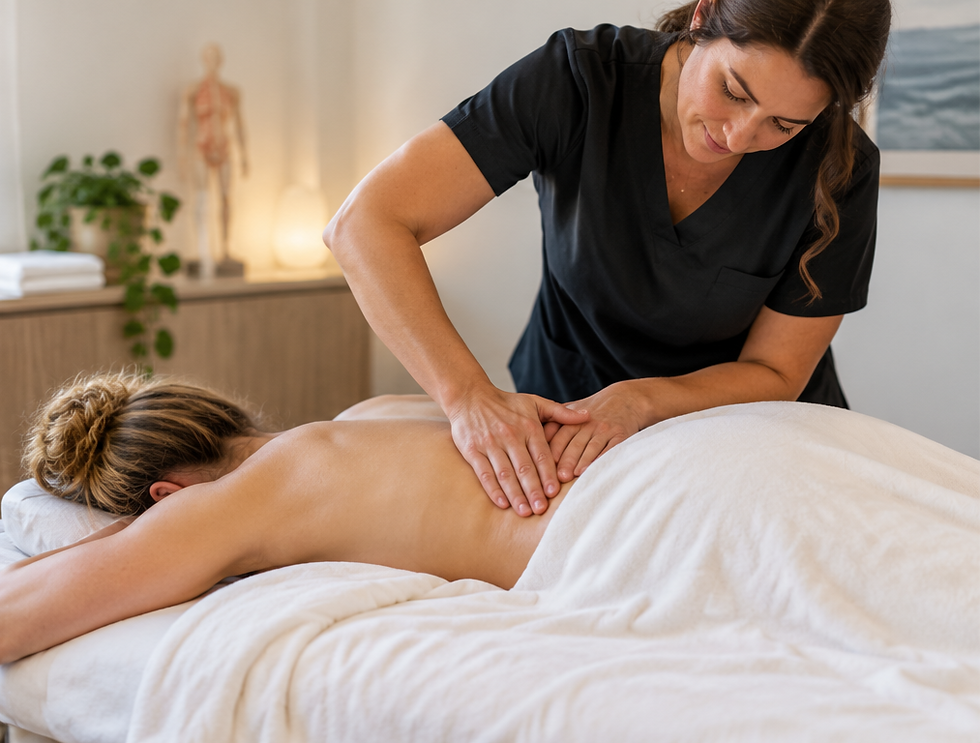
Massage therapy can be a valuable part of managing muscular tension and discomfort around the hips. At Muscle Precision Therapy, we recognize that hip discomfort doesn't always originate from one specific muscle. The surrounding muscles of the pelvis, lower back, and thighs work together, and tension or sensitivity in one area may influence how comfortable you feel during movement and rest.
A clinically focused massage session may address areas such as the gluteus maximus, gluteus medius, TFL, deep hip rotators, hip flexors, and surrounding lower back musculature.
Depending on your symptoms and tolerance, your massage therapist may use techniques intended to:
- Reduce muscular tension and sensitivity.
- Improve comfort with movement.
- Address tender or overworked muscles surrounding the hip.
- Encourage relaxation in muscles that have been working hard throughout the day.
- Complement a strengthening and movement program.
Importantly, deeper pressure isn't always better. When the tendons along the outside of the hip are already irritated, aggressive massage directly over the greater trochanter may make symptoms worse.
A thoughtful approach focuses on treating appropriate surrounding tissues without unnecessarily aggravating sensitive structures.
Massage therapy doesn't replace strengthening, rehabilitation, or medical treatment when needed, but it may provide meaningful short-term relief and help you feel more comfortable as you address contributing factors.
When Should You Seek Medical Evaluation?
Not every painful hip is simply a muscular issue.
Persistent or worsening pain, significant limitations in walking, or symptoms that repeatedly interrupt sleep deserve evaluation by a qualified healthcare professional.
Seek prompt medical care if hip pain follows a fall or injury, especially if you cannot bear weight. Fever, a hot or swollen joint, or new neurological symptoms also warrant medical attention.
Hip pain may sometimes originate from the hip joint itself, the lower back, or other medical conditions, making an accurate diagnosis important.
Final Thoughts
If your hip hurts when you sleep on your side, the problem may involve more than your mattress or sleeping position.
The way you sit, stand, walk, exercise, and use your muscles throughout the day can all influence how your hips feel when you finally lie down.
By improving daily body mechanics, strengthening appropriate muscles, reducing unnecessary pressure, and addressing muscular tension, you may be able to make your nights considerably more comfortable.
At Muscle Precision Therapy in South Jordan, Utah, our clinical massage therapists focus on understanding how muscles work together and tailoring treatment to your individual areas of discomfort.
If muscular tension is contributing to your hip discomfort, a targeted therapeutic massage may be a helpful addition to your overall care plan.
Ready to give your hips some attention? Schedule a therapeutic massage with Muscle Precision Therapy and let us help you work toward greater comfort and easier movement.
---
Disclaimer: This article is intended for general educational and informational purposes only and does not constitute medical advice, diagnosis, or treatment. Massage therapy is not a substitute for evaluation or care from a qualified healthcare professional. If you experience persistent, severe, or worsening hip pain, consult an appropriate medical provider.


